


Roads and Sewers for Adoption in Greater Manchester: What Developers Need to Get Right From the Start
For developers planning a new-build scheme, roads and sewers for adoption in Greater Manchester are easy to underestimate at the early design stage. Yet this is often where delays, redesign and unexpected site costs begin. If carriageways, drainage runs, manholes and connection points are not planned to adoptable standards from the outset, problems can emerge when inspections, tie-ins or handover are due.
At David Jackson Groundwork & Civil Engineering Ltd, we support commercial and industrial developments from our base in Horwich, Bolton, delivering groundwork, drainage, sewer connections, road construction and wider infrastructure works across Greater Manchester and the wider North West. With 38 years of industry experience and a track record on multi-million-pound projects, we understand how important it is to coordinate these elements early and build them correctly.
Why roads and sewers for adoption in Greater Manchester need early planning
Adoptable infrastructure is different from a simple private access road or a basic private drainage run. Once roads or sewers are intended for adoption, the construction standard, sequence of work, inspection points and supporting information become more important.
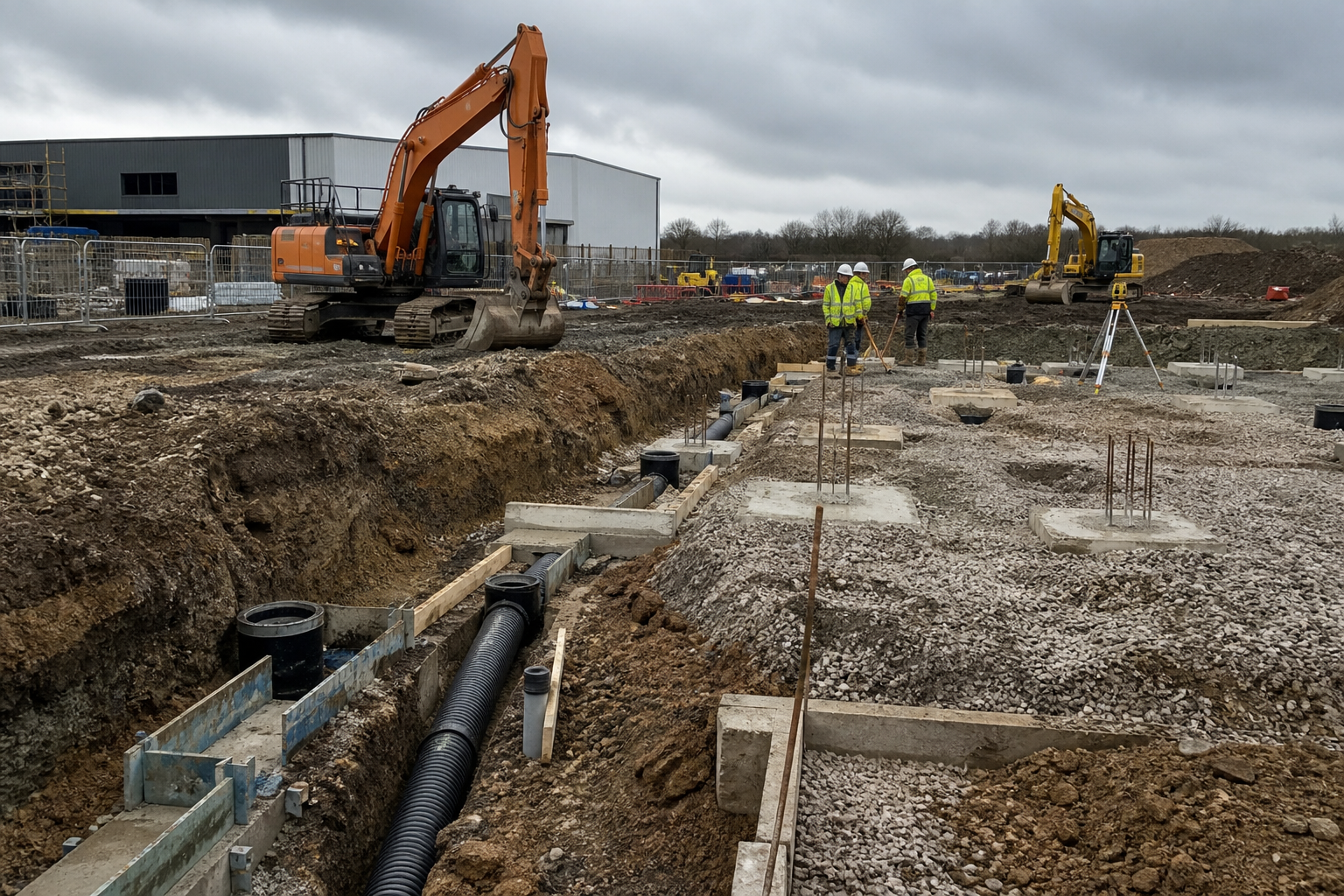
In practical terms, that means developers need to think beyond excavation and surfacing. Levels, gradients, trench depths, chamber positions, road build-up, drainage outfalls and access for future maintenance all need to work together before the site is closed up.
Adoptable work is only as good as the preparation behind it
On many schemes, the avoidable problems are not dramatic engineering failures. They are smaller issues that create delay:
road levels that do not coordinate properly with thresholds, kerb lines or drainage falls
foul and surface water systems that are not clearly separated
manhole chamber positions that clash with other infrastructure or final surfacing
pipe runs that become harder to inspect, alter or connect once other trades are on site
formation or sub-base issues that only become obvious when the carriageway package is under way
The earlier these risks are addressed, the better your chances of keeping programme, cost and site access under control.
What developers need to get right from the start
Site levels, line and gradients
Adoptable roads and drainage depend on disciplined setting out. Final levels affect almost everything: building thresholds, external hardstanding, carriageway falls, gully positions and sewer gradients.
If levels are adjusted late, one change can create several knock-on issues. A road that appears straightforward on a drawing can become awkward in the ground if falls do not suit the drainage strategy or if tie-ins at the site boundary are not resolved early.
Ground conditions, excavation and formation
Before permanent road construction starts, the site has to be properly prepared. Excavation depth, formation quality, imported stone requirements and the amount of muckshift all influence cost and sequencing.
As an experienced groundwork and civil engineering contractor, we know that weak formation or poorly timed excavation can compromise more than the road itself. It can affect drainage trenches, kerb lines, access for plant and the wider programme for the whole development.
Drainage strategy before surfacing begins
Developers are usually better served by treating drainage as an integrated part of the infrastructure package rather than a separate afterthought. Surface water drains, foul drainage, manhole chambers, attenuation measures and final connection points should be coordinated before surfacing and finishing trades restrict access.
This is particularly important on sites where there may also be attenuation tanks, flow control chambers, Hydrobrake systems, interceptor tanks or separator tanks as part of the wider drainage solution.
Coordination with other site infrastructure
Roads and sewers for adoption rarely sit in isolation. They need to fit around foundations, slabs, service corridors, yard areas and the day-to-day movement of delivery vehicles and plant.
That is why early input from a contractor with experience in drainage, pipe laying and sewer connections can make a real difference. Good coordination helps reduce rework and makes the handover stage more straightforward.
Road construction details that often delay adoption
Sub-base, kerbs and edge restraint
Adoptable road work depends on more than the finished surface. The layers beneath, the kerb installation and the overall containment of the carriageway all contribute to long-term performance.
If any of these elements are rushed or poorly sequenced, defects may not show immediately, but they can still lead to remedial work, additional inspection issues or programme disruption later.
Access roads, turning areas and heavier loading
Commercial and industrial sites often need more than a simple estate road. Vehicle movements, turning requirements and loading demands can change the way an external area should be built.
Developers need to consider how access roads interface with yards, entrances and high-traffic areas. The construction approach suitable for light use may not be appropriate where heavier commercial traffic is expected.
Works at the site boundary or highway interface
Where a new development connects into an existing adopted highway, planning and sequencing become even more important. Boundary tie-ins, access alterations and associated road works often need close coordination with the wider programme.
We have the capability to deliver infrastructure work that supports these more technical stages, including road construction, drainage connections and associated groundwork packages.
The sewer and drainage items that must be planned properly
Clear separation of foul and surface water drainage
One of the most important principles on a modern development is getting the drainage layout right from the start. Foul drainage and surface water systems need clear, well-planned routes, with chamber positions and connection details that suit the finished site layout.
Late design changes can be especially costly once trenches are backfilled, hard surfaces are installed or access becomes limited.
Manhole chambers, pipe laying and deep connections
Adoptable sewer work may involve specialist pipe laying, chamber construction and, on some sites, deeper connections than the developer first anticipated. These are not jobs where guesswork helps.
We undertake pipe laying, manhole chamber construction and groundworks and excavation for commercial infrastructure as part of wider site packages. For developers, that means one contractor can help manage the practical relationship between drainage, excavation, access and finished external works.
Attenuation, flow control and related drainage infrastructure
Many new-build sites also need water management measures as part of the overall drainage strategy. Depending on the scheme, that may include attenuation tanks, flow control chambers and other specialist components.
These elements need the right location, levels and build sequence. If they are left too late, they can interfere with other packages or create pressure at the end of the programme when site access is most restricted.
How we support developers across Greater Manchester
From our base in Horwich, Bolton, we work with clients across Greater Manchester and the wider North West on domestic, commercial and industrial groundwork and civil engineering projects. For developers, our value is not just in carrying out excavation or laying concrete. It is in delivering coordinated infrastructure works that help the whole site progress efficiently.
Our services include:
site clearance and excavation
building foundations and reinforced foundations
roads and sewers for adoption
surface water and foul drainage
pipe laying and manhole chambers
sewer connections
attenuation tanks and flow control systems
concrete yards, slabs and retaining walls
We can coordinate our work with clients' appointed professionals so that drainage, road construction, foundations and external infrastructure are aligned from the outset.
Developers also want reassurance that the contractor on site understands compliance, competence and safety. Our team is CITB and NPORS certified, SafeContractor accredited, holds NRSWA, Construction Plant Competence Scheme, Construction Skills Certification Scheme and Confined Spaces credentials, and is fully insured.
That combination of experience and practical site delivery is one reason clients use us on projects ranging from smaller developments to multi-million-pound schemes.
A practical pre-start checklist for developers
Before works begin, it is worth checking that the following points have been properly addressed:
Confirm whether roads, sewers or both are intended for adoption. Not every development follows the same route, so the required standard should be clear early.
Review site levels in detail. Carriageway falls, thresholds and drainage gradients must work together.
Check the drainage layout before surfacing starts. Foul drains, surface water drains, chambers and outfalls should be coordinated with the permanent site layout.
Understand excavation depth and ground conditions. This affects programme, imported materials and muckshift.
Plan the sequence at boundaries and connection points. These areas can easily become critical path items.
Choose a contractor who can deliver the package as a whole. Roads, drainage and supporting groundwork are usually easier to manage when the site team understands how each element affects the next.
Frequently asked questions
What does roads and sewers for adoption mean on a development?
It generally means the road, sewer or associated infrastructure is being built to a standard suitable for future adoption by the relevant authority or undertaker, rather than remaining entirely private. That affects design coordination, construction standards and inspection stages.
Do all new developments need adoptable roads and sewers?
No. Some developments retain private infrastructure, while others need roads, sewers or connection works that must meet adoptable standards. The right approach depends on the site layout, planning requirements and the wider infrastructure strategy.
When should a groundworks contractor be involved?
As early as possible. Early contractor input can help identify practical issues with levels, drainage routing, excavation, access and build sequence before those issues become costly on site.
Can one contractor handle road works, drainage and sewer connections?
Yes, and that can simplify coordination. We deliver roads and sewers for adoption, drainage systems, excavation, pipe laying, manhole chambers, sewer connections, foundations and wider infrastructure works as part of comprehensive groundwork packages.
Do you offer site visits for commercial developments in Greater Manchester?
Yes. We offer free, no-obligation site visits and written quotations for projects across Greater Manchester and the wider North West, and we can travel further for larger commercial projects.
Plan adoption requirements before they become a site problem
If you are planning a development and need roads and sewers for adoption in Greater Manchester, the best time to address the detail is before the job reaches a pressure point. Early coordination can help reduce redesign, protect programme and make the transition from groundwork to completed infrastructure much smoother.
At David Jackson Groundwork & Civil Engineering Ltd, we bring 38 years of industry experience to road construction, drainage, sewer connections and infrastructure works across Greater Manchester. Book a free, no-obligation site visit and written quotation to discuss adoptable roads, sewers and supporting groundwork for your development.
Comments